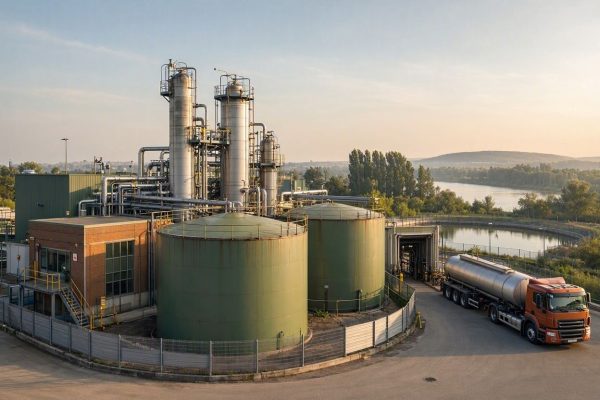
A regional supply chain that turns animal by-products and used cooking oil into renewable energy and second-generation biodiesel
In the province of Latina, a family of companies is showing how industrial symbiosis can turn an environmental liability into a strategic resource. The ILSAP Group, comprising Roma Service, ILSAP Latina, ILSAP Lamezia Terme and Power Oil, has built an integrated regional chain that collects, transports, stores and transforms animal by-products and exhausted vegetable oils, converting them into refined oils, animal fat-derived electricity, biodiesel and glycerin.
ILSAP’s story is itself a case of adaptive innovation. Founded in 1986 to process animal by-products for the zootechnical feed market, the company was forced to reinvent its entire business model when the BSE crisis of 2000 closed that market to processed animal proteins. Rather than scaling down, ILSAP became one of Italy’s few authorised plants able to handle high-risk specified material, and redirected its output toward energy recovery turning a public-health constraint into the seed of a new circular economy.
Today the Latina plant processes up to 10 tonnes per hour of animal by-products, and its cogeneration unit converts 2,000 tonnes per year of animal fat into roughly 8,000 MWh of renewable electricity. At the Lamezia Terme site, twin refining and transesterification lines run continuously to produce around 200 tonnes of refined oil, 200 tonnes of biodiesel and 20 tonnes of glycerin every day, entirely from waste feedstocks — used cooking oils, animal fats and non-food vegetable oils, never from food crops.
This matters well beyond the balance sheet. By producing second-generation, EN 14214-compliant biodiesel from residues instead of virgin feedstock, ILSAP delivers a homegrown, renewable alternative to fossil diesel without competing with food production or agricultural land, precisely the kind of local energy resilience that regions seek as they reduce dependence on imported petroleum. Power Oil’s collection network alone serves 8,000 clients across Italy, working with municipal utilities to keep used cooking oil out of the environment and into the supply chain.
With 85 employees across Rome, Latina and Lamezia Terme, and infrastructure recognised as a strategic national asset under Italian law (L. 35/2012), ILSAP is a concrete example of how connecting waste streams across sectors – food processing, catering, and municipal collection- can build regional energy capacity while reducing environmental impact.