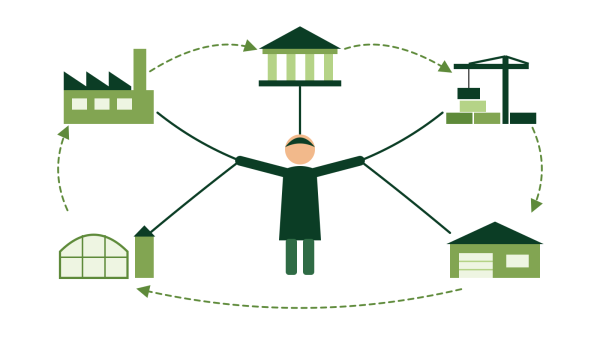
Europe’s competitiveness debate is about markets, capital and technology. Twenty years of research on industrial symbiosis point to another ingredient: the people who get neighbouring companies to talk to each other.
Samira KHEMKHEM, University of Strasbourg (UNISTRA), INSET project coordinator
What the Draghi report says, and what it leaves open
When Mario Draghi delivered The future of European competitiveness in September 2024, circularity entered the conversation as a matter of economic security. The report treats it as one of the tools Europe has to reduce its external dependencies, and it is frank about what stands in the way: secondary raw materials often cost more than primary ones, and recycling often costs more than landfilling. Its answers are structural. It calls for a genuine single market for waste and circularity, devotes a full chapter to closing the skills gap, and encourages green regional industrial clusters around energy-intensive industries. These levers matter. But a single market for secondary materials does not, by itself, tell a joinery that the foundry two streets away is paying to dispose of exactly what it needs. Someone has to make that connection, earn the trust of both managers, and stay long enough for the exchange to become routine. The report sets the frame. It says little about who does this work on the ground.
What research has shown for twenty years
The scientific literature is remarkably consistent on this point. In a landmark article, Marian Chertow (2007) showed that the most durable symbioses were rarely designed from above. They grew out of exchanges between firms, and public action was most useful when it “uncovered” these embryonic links and helped them grow.
Raymond Paquin and Jennifer Howard-Grenville (2012) followed the United Kingdom’s National Industrial Symbiosis Programme and described facilitated symbiosis as a middle path between spontaneous and planned networks. They broke the facilitator’s work into three movements: conversation, connection and co-creation. Their warning is still relevant. Chance encounters between firms remain essential, and when funding tightens and targets take over, the pipeline of future exchanges dries up. More recently, Schlüter and colleagues (2022) mapped the role across the Nordic countries. They identified five families of tasks: developing linkages, coordinating, managing knowledge and capacity, assessing and distributing value, and creating the conditions to scale up. They also listed the skills these tasks require, from social skills to ethics, and concluded that no single person can hold them all. Facilitation works best as a team effort. Patala, Salmi and Bocken (2020) add that these intermediaries constantly face dilemmas that no software can settle for them.
The French lesson: a territory is a resource
French research goes one step further by putting the territory at the centre. In France the field is called écologie industrielle et territoriale (EIT), and the adjective is not decorative. Beaurain and Brullot (2011) analyse it as a process of territorial development that rests on proximity, both geographical and relational. Brullot, Maillefert and Joubert (2014) show that the strategies of local actors and the way they are governed shape what an initiative can achieve. Studying Dunkirk, Kasmi and colleagues (2017) reach the same conclusion: success depends on territorial governance. This is why French practitioners speak of an animateur: literally, someone who gives life. The French agency for ecological transition (ADEME) now recommends that a preliminary study and a dedicated EIT facilitator precede any new initiative, and the national SYNAPSE network has connected these professionals since 2018. The latest national review, published by ORÉE and ADEME in 2024 and based on 71 initiatives, puts their durability at the heart of the question. INSET’s comparison of five countries points the same way: it finds that France has the most structured intermediary ecosystem, and credits ADEME’s investment in a national network of professionals.
A profession that is still invisible
The INSET Policy Brief (2026) reaches the same diagnosis from the field. Across France, Italy, Lithuania, Slovenia and Spain, it finds that skilled facilitation is among the most consistent enabling conditions for industrial symbiosis. Exchanges, it notes, do not happen spontaneously. Someone has to identify partners, build trust between firms, work through the regulatory questions, assess feasibility and formalise the agreement.
Yet in none of the five countries, and not at EU level, is this a recognised occupation. Practitioners work under a dozen different titles, with no common framework, training pathway or quality standard. In the Brief’s own words, “capacity evaporates when project funding ends”. The 31 stakeholders consulted on the draft agreed. Local authorities in particular described a dedicated territorial facilitator as essential wherever small companies cannot carry the cost and risk of a project alone.
The partners who joined us in Strasbourg for the European Day of Industrial Ecology, from business clubs, port authorities and local associations, are exactly these people.
Three consequences for policy and training
- Fund facilitation as infrastructure. If circularity is a pillar of competitiveness, the people who make it happen locally deserve the same continuity as a road or a network. The Brief’s Recommendation 2 is concrete: fund or designate at least one post dedicated to facilitation in each participating region, hosted by an existing organisation such as a development agency, a chamber of commerce or an industrial estate manager. Its finance recommendations add that existing schemes should accept group applications and pay for facilitation and matchmaking, not only for equipment.
- Recognise and train the profession. The INSET competence framework and curricula for Industrial Symbiosis Planners and Project Managers give the role a technical basis. Recommendation 1 proposes a faster route than waiting for a European standard: enter these profiles in national occupational repertoires, such as the RNCP in France, and use those entries as evidence for a later revision of ESCO. Universities and vocational training providers have a direct responsibility here.
- Measure what facilitators actually produce. The Brief proposes a minimum dataset for every facilitated exchange, including material category, annual tonnage, estimated CO2 savings and number of enterprises. That is a necessary start. But tonnes come late. Before them come meetings held, relationships built and trust earned, and evaluation that ignores this early work will always conclude that facilitation is too slow.
Mario Draghi asks Europe to invest in what makes it productive. The trust between neighbouring companies is one of those assets, and it has stewards. It is time to give them a name, a status and a future.
References
Beaurain, C. and Brullot, S. (2011). L’écologie industrielle comme processus de développement territorial : une lecture par la proximité. Revue d’Économie Régionale & Urbaine, 2, 313-340.
Brullot, S., Maillefert, M. and Joubert, J. (2014). Stratégies d’acteurs et gouvernance des démarches d’écologie industrielle et territoriale. Développement durable et territoires, 5(1). https://journals.openedition.org/developpementdurable/10082
Chertow, M. R. (2007). “Uncovering” industrial symbiosis. Journal of Industrial Ecology, 11(1), 11-30.
Draghi, M. (2024). The future of European competitiveness. Part A and Part B. European Commission. https://commission.europa.eu/topics/competitiveness/draghi-report_en
INSET (2026). INSET Policy Brief. Work Package 5, Activity 4, October 2026. Erasmus+ project 2023-1-FR01-KA220-VET-000158456, coordinated by the University of Strasbourg. https://inset-symbiosis.eu/inset-policy-brief-11-recommendations-to-advance-industrial-symbiosis-in-europe
Kasmi, F., Laperche, B., Merlin-Brogniart, C. and Burmeister, A. (2017). Écologie industrielle, milieu innovateur et gouvernance territoriale : le cas de Dunkerque (Nord-France). Canadian Journal of Regional Science.
ORÉE and ADEME (2024). État des lieux de l’écologie industrielle et territoriale en France : évaluation, maturité, pérennité.
Paquin, R. L. and Howard-Grenville, J. (2012). The evolution of facilitated industrial symbiosis. Journal of Industrial Ecology, 16(1), 83-93.
Patala, S., Salmi, A. and Bocken, N. (2020). Intermediation dilemmas in facilitated industrial symbiosis. Journal of Cleaner Production, 261, 121093.
Schlüter, L., Mortensen, L., Drustrup, R., Gjerding, A. N., Kørnøv, L. and Lyhne, I. (2022). Uncovering the role of the industrial symbiosis facilitator in literature and practice in Nordic countries: an action-skill framework. Journal of Cleaner Production, 379, 134652. https://doi.org/10.1016/j.jclepro.2022.134652