Waste management has always been considered a cost item. Disposal, transport, documentation, payment.
A necessary but invisible activity, rarely seen as strategic.
Today, however, with the entry into force of the Corporate Sustainability Reporting Directive (CSRD) and the new ESRS standards, European companies are required not only to reduce their environmental impact, but to measure it, certify it, and make it reportable.
Processes such as Industrial Symbiosis — namely the collaborative use of waste streams between companies — remain one of the most promising yet still underutilized strategies to support businesses in optimizing waste management and creating new value. While European initiatives like INSET work to raise awareness and develop the necessary capabilities for these practices through education and digital tools, the question remains:
how does all this translate into real-world implementation?
Sistemi Formativi Confindustria, has identified Regusto as a best practice example providing a compelling answer. Selected by SFC for its proven results, Regusto’s journey — from facilitating food donations to enabling cross-sector resource exchanges — demonstrates how digital platforms can support industrial symbiosis.
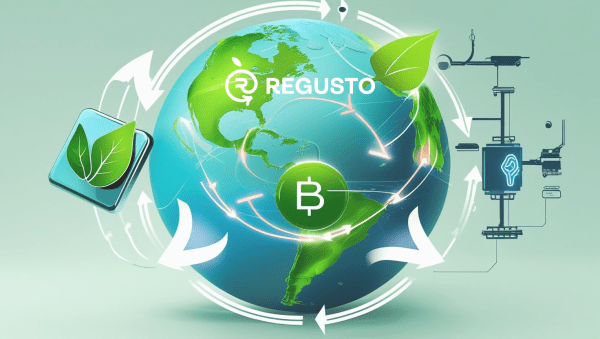
Within this shift — from operational cost to ESG data — Regusto fits in as an Italian digital platform that, over the past ten years, has transformed surplus recovery into a true infrastructure for industrial symbiosis and sustainability reporting.
Founded in 2016, alongside Italy’s Law 166 against food waste, Regusto initially focused on food. But its scope soon expanded: non-food items, furniture, technical equipment, industrial by-products, construction materials, and upcycling.
What started as a system to facilitate donations has now become a digital ecosystem connecting companies, non-profit organizations, and public administrations, transforming waste streams into traceable environmental, social, and economic value.
From food to the circular economy: a “natural” evolution:
“The creation of Regusto followed both market developments and regulatory changes,” explains Paolo Rellini, CEO and Co-Founder.
“We started with food, then companies asked us to manage non-food items, furniture, and by-products. It was an almost natural evolution, driven by real needs.”
The model, designed from the outset, has remained the same:
companies make their surplus available, non-profit organizations recover it, while public administrations monitor the flows across the territory.
Three actors, each with tangible benefits, connected through a digital platform.
From waste management to ESG value creation:
Traditionally, disposal represents only a cost.
Regusto reverses this logic: surplus becomes measurable assets.
Each recovery operation generates certifiable data: CO₂ avoided, resources saved, economic value recovered, social impact on the territory, reduced disposal costs, and tax benefits.
These indicators are processed according to international standards, validated with academic partners and third parties, and automatically feed into ESG reports ready for sustainability reporting.
“In fact,” explains Rellini, “companies that join already obtain part of their ESG report developed. Everything we track becomes reportable data. Not just communication, but verifiable numbers.”
The result is a paradigm shift:
recovery is no longer an occasional activity, but a structured, scalable process that can be integrated into corporate strategy.
The technological infrastructure:
At the core of the system is a platform that combines:
- geolocalized matching between supply and demand
- digitalization of document flows
- blockchain-based traceability
- artificial intelligence algorithms for logistics optimization
- certified calculation of environmental, social, and economic impacts
- automated ESG dashboards and reports
However, technology is not just an operational tool.
“Our role also includes project support,” Rellini emphasizes.
“We help companies digitize processes, access tax incentives, and simplify bureaucracy. We make recovery simple and convenient.”
A network growing across the territory:
Today, Regusto connects over 2,000 non-profit organizations — including Banco Alimentare, Caritas, the Red Cross, and Progetto Arca — alongside major retail and industrial groups.
The local model reduces logistical distances and facilitates exchanges, but the platform is designed to be scalable at regional and European levels.
Concrete use cases include:
- recovery of surplus retail food and non-food items
- redistribution of PPE and healthcare materials
- management of corporate relocations with furniture recovery (Generali, Deloitte, eBay, L’Oréal, Saipem)
- thousands of goods diverted from disposal and put back into circulation
At the same time, B2B pilots are emerging, where one company’s waste becomes another’s production input, creating true industrial symbiosis schemes.
Do platforms really work at the local level?
When asked whether models like this only make sense at a territorial scale, Rellini explains:
“The local dimension is essential to initiate relationships and reduce logistical impacts. But technology enables scaling. The model can be replicated in other territories, districts, or countries. In fact, that’s where it becomes truly powerful.”
Regusto is currently launching pilot projects in Spain and German-speaking countries, where stricter regulations make traceability even more strategic.
The construction sector: a new frontier
Among the sectors with the greatest potential is construction.
“It’s a complex world, but with enormous environmental impacts and huge recovery opportunities,” the CEO notes.
“In Spain, there are already regulatory obligations pushing companies to track and certify materials. In Italy, we are still in an exploratory phase, but interest is strong.”
Construction sites, demolitions, and new developments generate large volumes of recoverable materials. Digitizing them means obtaining environmental certifications, financial advantages, and easier access to green credit.
What is slowing down adoption?
According to Rellini, the main barrier is cultural and regulatory.
“In Italy, without an obligation or economic incentive, companies struggle to take action. Where there is a concrete benefit, change happens quickly.”
For this reason, Regusto also works with industry associations and public administrations, which can use territorial data for environmental policies, monitoring, and even waste tariff reductions.
A data infrastructure for circularity:
After ten years, the project has moved beyond the logic of simple donation. Regusto is increasingly positioning itself as a digital infrastructure for the circular governance of territories, capable of:
- reducing waste and costs
- generating social impact
- producing certifiable ESG KPIs
- simplifying reporting
- fostering industrial symbiosis between companies
In a Europe that demands transparency and measurability, the value lies not only in recovering resources, but in demonstrating the impact generated.
It is precisely in this transition — from waste to certified data — that Regusto’s distinctive contribution takes shape.