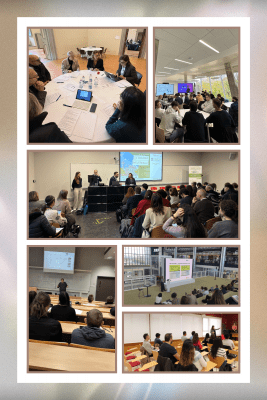
On a November morning in Barcelona’s DFactory Innovation Hub, 24 professionals gathered to explore how industrial waste from one company could become valuable resources for another. In a Kaunas university classroom, students engaged with real-world case studies bringing circular economy theories to life. And in Italy’s Tiber Valley, business leaders mapped hidden connections between their operations that could unlock sustainability synergies.
Moreover, in Lyon, the INSET workshop held on November 25, 2025, reached over 90 students from the University of Strasbourg’s business management programs within a broader Industrial Ecology event, equipping them with skills to address the management challenges that companies face in leading and operating within the ecological transition process of industrial systems. In Yecla, the November 10, 2025 workshop brought together 21 representatives from industry, education, and public bodies to explore the INSET Toolkit for Industrial Symbiosis. In Maribor, on December 3, 2025, the INSET workshop reached 21 students interested in pursuing INSET pathways to deepen their ability to design and manage local industrial symbiosis initiatives.
The events coordinated across Europe demonstrate how the INSET project Toolkit is supporting industrial collaboration and resource efficiency. The series of workshops has just concluded with promising prospects for the development of capacity building among policy makers to be able to use IS business models and close the resource loop, thanks also to the use of:
– A collection of good practices spanning territories, sectors and types of IS coordination, with the aim of clarifying the concept of industrial symbiosis, assessing its pros and cons, and learning how many types of products could be traded between companies and generate new value.
– A support manual for policy makers and IS professionals to initiate dialogue between stakeholders and support the feasibility of Industrial Symbiosis projects. Here too, the use of concrete cases to describe the aims and methods of interaction with policy makers gives the manual a useful dimension, supporting the creation of new connections between local actors
– Two specialist training courses for IS Planners and IS Managers, roles that are essential for translating IS into concrete initiatives, planned and managed consistently in line with the development, administration and reporting functions of businesses.
– the Validu App, bringing together all the tools offered by INSET and ensuring 24/7 accessibility.
The workshop series has just concluded with compelling results about the future of Industrial Symbiosis in these regions.
The INSET workshops’ journey began in Kaunas, Lithuania, on October 22, where Syxis partnered with Kaunas University of Technology – KTU to introduce 17 bachelor’s students to Industrial Symbiosis. The Director of KTU opened the session, contextualizing IS within regional industrial development strategies. What followed was more than a lecture—it was a glimpse into how the next generation of sustainability professionals will approach circular economy challenges.
The story continued in Città di Castello, Italy, where something remarkable happened. Rather than simply presenting the INSET Toolkit, SFC Sistemi Formativi Confindustria, in collaboration with Fondazione Progetto Valtiberina and supported by Confindustria dell’Alta Valle del Tevere – the organization representing companies at local level – invited 14 local companies and 8 local stakeholders to roll up their sleeves and use the INSET tools in real-time. Divided into three working groups, participants analyzed their own territory—the Tiber Valley, a cross-regional area spanning Umbria and Tuscany. Using the IS Networking Handbook, they mapped stakeholders, identified potential material flows, and discussed what makes an IS project truly successful. The atmosphere shifted from theoretical to practical, from “what if” to “how can we.”
In Barcelona, Spain, on November 3, Símbiosy embedded the INSET workshop within the II National Meeting of Industrial Symbiosis Projects. With support from the Catalan Waste Agency (ARC) and Consorci de la Zona Franca, the workshop attracted a diverse mix of public authorities, companies, consultants, and academics—all key players in Spain’s growing IS ecosystem. What made this workshop particularly significant was the profile of attendees: 37% represented public authorities, the very policymakers who can create enabling conditions for IS at regional and national levels. The gender balance was notable too, with 67% female participation, reflecting the inclusive nature of sustainability leadership.
In Yecla, Spain, on November 10, CETEM hosted 21 stakeholders from companies, clusters, and public institutions to test the INSET Toolkit. Survey results revealed strong validation: 95% rated the resources as relevant to their professional context, while 78% recognized INSET as highly relevant for business sustainability transformation. Participants particularly valued the toolkit’s practical approach, calling for more site visits to real IS examples and pilot projects to demonstrate tangible industrial synergies in the furniture and wood sectors.
In Lyon, France, on November 25, the University of Strasbourg integrated the INSET workshop into a larger Industrial Ecology event, reaching over 90 business management students. This strategic integration exposed future business leaders to the management competencies needed to navigate and lead companies through the ecological transition of industrial systems, embedding IS principles into the next generation of corporate decision-makers.
Last but not least, the INSET workshop in Maribor, Slovenia, on December 3 engaged 21 students eager to develop expertise in designing and managing local industrial symbiosis initiatives. Their interest in pursuing the INSET training pathways demonstrates growing recognition among emerging professionals that IS skills will be essential for future sustainability careers.
The success of the INSET workshop series wasn’t accidental. Three factors emerged as critical:
1. Strategic local partnerships
Each workshop benefited from deep collaboration with established local networks. The Catalan Waste Agency and Consorci de la Zona Franca in Barcelona brought institutional credibility and access to key stakeholders. Kaunas University of Technology provided the academic environment and student engagement. Fondazione Progetto Valtiberina and Confindustria Alta Valle del Tevere in Italy opened doors to a tightly-knit business community and provided a real territorial context for practical application.
2. Practical, hands-on engagement
The most successful moments came when participants stopped listening and started doing. In Italy, the working group sessions transformed understanding. In Lithuania, students explored the digital platform directly. In Spain, participants engaged with all four toolkit components and provided detailed feedback on usability. Participants weren’t just learning about IS—they were experiencing how INSET tools could help them implement it.
3. Diverse but focused audiences
Each workshop targeted different stakeholder groups while maintaining focus. Students in Lithuania represented the future workforce. Business leaders in Italy represented practical implementation needs. The mixed stakeholder group in Spain—public authorities, companies, consultants—represented the ecosystem approach that IS requires. This diversity enriched discussions while allowing each workshop to maintain clear objectives tailored to local contexts.
The INSET Toolkit emerged from these workshops not just promoted, but validated. Participants engaged with all four components—the training course, the best practices publication, the networking handbook, and the mobile app—and confirmed that together, they provide a comprehensive framework for IS capacity building.
About INSET
The INSET project represents a transnational effort to build capacity for Industrial Symbiosis across Europe. Coordinated by the University of Strasbourg, with partners including Símbiosy (Spain), Syxis (Lithuania), SFC Sistemi Formativi Confindustria (Italy), CETEM, and SIMBIOSY (Spain), the project has developed a comprehensive toolkit for training IS planners and project managers.
All INSET resources are freely available at: https://inset-symbiosis.eu/inset-
INSET workshops roadmap to enhance Industrial Symbiosis education across Europe