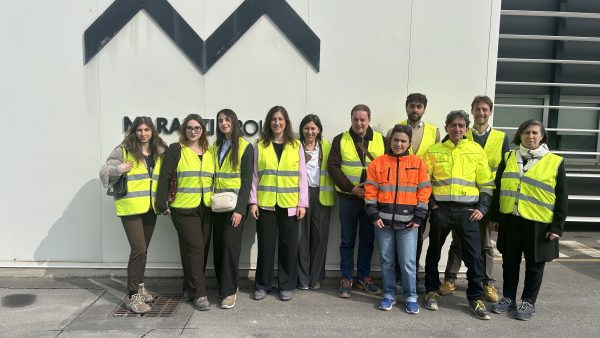
The structure of the INSET Observatory was presented and discussed during a workshop hosted at Marazzi’s headquarters in Sassuolo on 11 March 2026. Bringing together industry representatives, researchers, and circular economy stakeholders, the event provided an opportunity to validate the Observatory as a knowledge hub for industrial symbiosis and to gather feedback on its future development and practical use.
A key step forward for the INSET project took place on 11 March at the Marazzi headquarters in Sassuolo, where a dedicated workshop brought together a diverse group of stakeholders to validate the toolkit and the design of the INSET Observatory.
The event was organised by SFC Sistemi Formativi Confindustria in collaboration with Confindustria Ceramica and drew stakeholders from across the industrial symbiosis ecosystem: Environmental managers from Marazzi, the sectorial industry association Confindustria Ceramica, research institution Centro Ceramico, and ACR+, the international association of public authorities and local governments committed to circular economy.
The Observatory has been presented by CETEM and SYXIS as a curated knowledge hub bringing together scientific contributions, training materials, legislative updates, and other relevant resources on industrial symbiosis. Its core purpose is to highlight good practices, real-world examples, and innovations in the field, making cutting-edge knowledge accessible and actionable for a wide range of users.
It represents the culmination of INSET’s work, which has already produced a comprehensive good practices collection and an extensive training programme for both IS Project Designers and IS Managers. The Handbook on Industrial Symbiosis Networking sessions is also available, among the INSET tools to support policy makers in make Industrial Symbiosis real.
What the consultation revealed?
Feedback from participants was strongly positive. The Observatory was recognised as a genuinely valuable initiative, directly addressing the need, particularly felt by policy makers, for a single, up-to-date, and authoritative hub on industrial symbiosis.
At the same time, participants flagged the importance of avoiding duplication with existing platforms, such as material exchange marketplaces, and encouraged the INSET team to seek synergies rather than overlap.
Looking ahead, participants also highlighted potential business-side applications: if the Observatory were to include deep-dive, sector-specific studies, it could serve as a powerful tool to fuel industry dialogue and knowledge-sharing on industrial symbiosis at the company level.
The INSET group is now leading the way in drafting the Policy Brief, a document that will set out all the key elements of the project and will help bridge the gap between what has already been achieved and what still needs to be done to make the IS a reality.