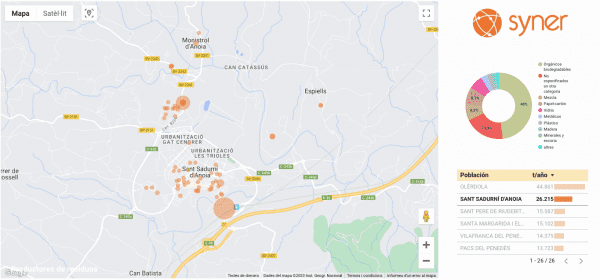
Industrial Symbiosis begins long before companies collaborate. Mapping resource flows helps territories identify hidden opportunities, understand industrial ecosystems and support data-driven circular economy strategies.
Industrial Symbiosis is often associated with collaboration between companies: one company’s waste becomes another company’s resource. But before any exchange can happen, there is a more fundamental challenge to solve.
How do we know which opportunities actually exist?
In many industrial territories, potentially valuable resources remain invisible. Residual heat, organic by-products, secondary raw materials, wastewater streams or underused infrastructure are often dispersed across industrial areas without a clear understanding of their quantity, location or potential compatibility with other actors.
As a result, many opportunities for Industrial Symbiosis are never even identified.
This is one of the less visible barriers to circular economy implementation: the lack of operational knowledge about territorial resource flows.
Most existing data systems were not designed to identify industrial synergies. Waste classifications, aggregated statistics or sectoral databases rarely provide the level of detail needed to understand how resources circulate within a territory. In practice, this makes it difficult for companies, industrial parks or public administrations to detect viable opportunities for collaboration.
Industrial Symbiosis therefore begins much earlier than the collaboration phase itself. It starts with understanding the industrial ecosystem.
This is where territorial analysis and resource mapping become essential.
By combining different sources of information — such as industrial activity data, land use, waste declarations, sectoral patterns or energy consumption estimations — it becomes possible to build a clearer picture of how materials and resources move across a territory. The objective is not necessarily to obtain perfect data, but to generate sufficient intelligence to identify realistic opportunities and support decision-making.
This type of analysis helps answer practical questions:
Which sectors generate potentially valuable residual resources?
Where are compatible resource flows geographically concentrated?
Which industrial areas show potential for heat recovery, biomass valorisation or material exchanges?
Where could collective infrastructure become viable?
In this sense, resource mapping is not simply a technical exercise. It is a strategic planning tool.
Several territorial initiatives across Europe already demonstrate the value of this approach. In rural and industrial regions alike, mapping exercises have helped identify local biomass potential, estimate recoverable organic flows, assess energy self-sufficiency opportunities or detect possible synergies between companies that had never previously interacted.
These analyses often become the starting point for broader Industrial Symbiosis strategies, helping territories prioritise investments, design infrastructure and create the conditions for future collaboration.
This perspective is also increasingly reflected in Industrial Symbiosis training and capacity-building initiatives. Within the INSET approach, competencies related to systemic thinking, data analysis, resource mapping and opportunity identification are considered essential for future Industrial Symbiosis professionals.
Because Industrial Symbiosis is not only about connecting companies.
It is about understanding how industrial ecosystems function before collaboration even starts.