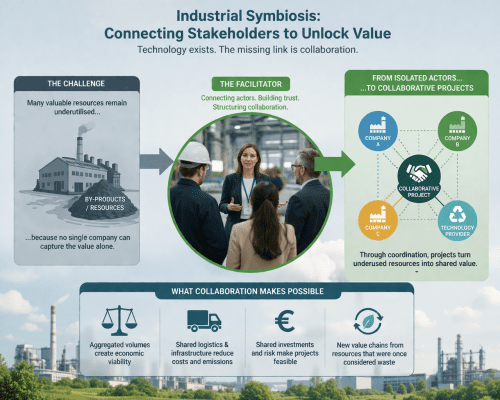
Many industrial symbiosis solutions already exist, yet remain unrealised. The real gap is not technical—it is the ability to connect stakeholders, structure collaboration and turn opportunities into viable projects.
In industrial symbiosis, the conversation often starts with technology: new recovery processes, innovative treatment solutions, or alternative uses for industrial by-products. But in practice, technology is rarely the main bottleneck.
The real challenge lies elsewhere.
Every year, large volumes of potentially valuable resources remain unused—not because solutions do not exist, but because they require multiple actors to work together. In many cases, no single company can capture the value alone. Making these opportunities viable means aligning interests, aggregating flows, sharing risks, and coordinating decisions across organisations.
This is where many symbiosis initiatives stall.
Industrial symbiosis is often presented as a matter of matching a waste stream with a use. In reality, the most impactful solutions are not simple exchanges—they are structured, multi-actor projects. They involve designing new value chains, building agreements between companies, and ensuring long-term operational and economic viability.
This requires a specific set of capabilities that are still largely underdeveloped: the ability to connect stakeholders, facilitate collaboration, and structure projects across organisational boundaries.
In this sense, industrial symbiosis is not only a technical or environmental challenge—it is also a skills challenge.
As highlighted in the INSET training approach, roles such as the IS Planner and the IS Project Manager are essential to bridge this gap: identifying opportunities, engaging stakeholders, and managing the complexity of implementation across different actors .
These roles are not about replacing companies or making decisions on their behalf. They are about enabling collaboration—reducing friction, building trust, and translating potential into concrete, operational projects.
Reframing industrial symbiosis in this way changes the question. Instead of asking what each company can do with its own resources, it becomes a question of what can be achieved when the right actors are connected and supported by the right capabilities.
Because in many cases, the difference between an unrealised opportunity and a functioning symbiosis project is not technology—it is the ability to make collaboration work.