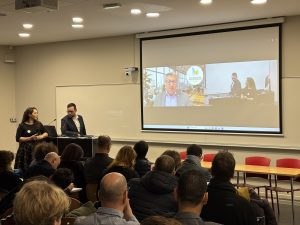
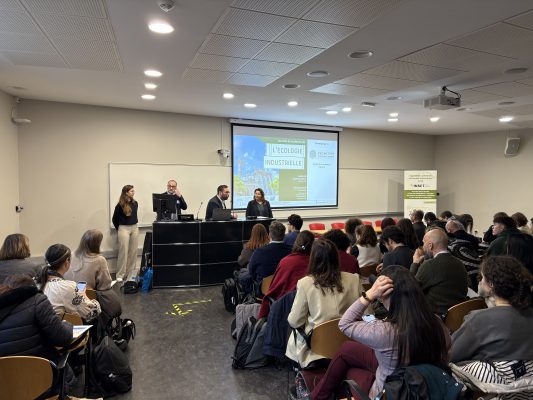
On November 25, 2025, the University of Strasbourg hosted the European Day of Industrial Ecology (JEEI), a flagship event led by IRIUS and the European project INSET. Held as part of the European Week for Waste Reduction, the event brought together a large and diverse audience of students, academics, public institutions and socio-economic stakeholders, united by a shared ambition: to collectively shape the ecological transitions of tomorrow.
A key topic for Europe’s transitions
Under the theme “Local loops, global impacts”, the event highlighted industrial ecology as a strategic lever for rethinking production and consumption systems. Through a keynote lecture, testimonials from practitioners and a roundtable discussion, participants explored both the territorial dimension of ecological transition and the skills required to support it. Discussions emphasized the importance of cooperation between universities, businesses and public institutions, as well as the growing role of innovation and circular economy approaches within European climate and energy policies.
A dynamic multi-stakeholder ecosystem at the heart of the event
One of the defining strengths of the JEEI was the remarkable diversity and scale of its participation. The event mobilised a broad range of internal stakeholders from the University of Strasbourg, demonstrating strong institutional engagement across faculties, services and initiatives. Beyond the university, the JEEI brought together a rich ecosystem of external partners, highlighting the deep anchoring of the INSET project within its socio-economic and European environment. This included the Industrial Ecology Club of Aube (CEIA), Autonomous Port of Strasbourg, Initiatives Durables, local and regional authorities, economic development actors, as well as numerous European partners involved in Erasmus+ projects. Companies, professional organisations and associations were also strongly represented, contributing concrete field experiences and showcasing innovative practices in industrial ecology.
This broad participation created a vibrant space for dialogue, collaboration and knowledge exchange, reinforcing the JEEI as a truly European platform connecting academia, public institutions and industry around shared sustainability challenges.
A strong professionalisation experience for students
At the heart of the INSET project, the JEEI fully embodies the ambition to bridge academic training and real-world practice. For students from IRIUS and across the University of Strasbourg, the event provided a meaningful immersion into a rapidly emerging sector with strong career potential. It contributed to the development of key transversal skills, including project management, communication and intercultural cooperation, while also creating direct opportunities to engage with potential employers and partners. In addition, it offered a valuable platform for showcasing academic work within a professional and applied context.
A structuring initiative within the INSET ecosystem
Beyond a one-day event, the JEEI is part of a broader INSET dynamic aimed at building sustainable connections between European industrial ecology stakeholders. It reinforces the role of universities as key actors in ecological transitions, at the crossroads of education, research and innovation. By bringing together academic knowledge, professional expertise and territorial initiatives, the JEEI confirms its ambition to become a structuring and recurring European event, supporting a more sustainable, collaborative and resilient economy.