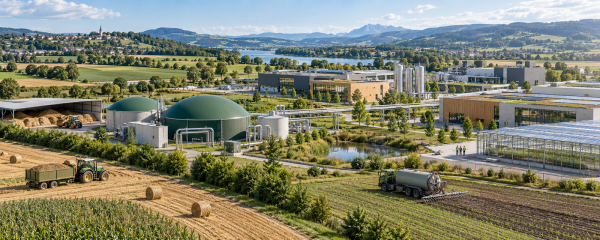
Bioparks can connect local resources, businesses and infrastructure. Discover why industrial symbiosis facilitators—and the skills to support them—are essential to turning these opportunities into practical collaborations.
Bioparks: connecting resources, businesses and territories
Bioparks can be much more than industrial areas specialising in bio-based activities. Planned with a circular economy approach, they can connect businesses, agriculture and infrastructure to make better use of local resources and create new economic opportunities.
Many territories bring together agricultural, livestock, forestry, agri-food and industrial activities. These generate resources that could be put to new uses —such as biomass, by-products, water, energy and nutrients— while businesses seek local sources of raw materials and energy, ways to reduce costs and greater resilience. Industrial symbiosis can help connect these needs by exploring how a resource left over from one activity could become an input for another.
For example, livestock manure can be used to produce biogas and energy, while the resulting digestate can return to agriculture as fertiliser. Agricultural residues and food-industry by-products can also be recovered, infrastructure can be shared, and waste heat from one activity can be used by another. Each opportunity depends on the characteristics of the territory, the resources available and businesses’ needs.
From industrial park to productive ecosystem
The difference between a conventional industrial park and a biopark lies in how relationships between businesses are planned. Proximity does more than make day-to-day operations easier: it creates opportunities to exchange resources, share services and develop new value chains. A biopark is therefore more than a greener industrial area; it is a productive ecosystem connected to the resources and needs of its territory.
This approach also changes how these areas are planned. Alongside deciding where businesses should locate, it is important to consider which resources are available, who could use them, and what infrastructure or conditions would enable connections. Taking these opportunities into account from the outset can help shape a site that supports synergies and attracts complementary activities.
However, locating businesses close to each other does not guarantee that they will collaborate. Opportunities need to be identified and assessed, participants’ needs understood, and technical, economic, regulatory and organisational issues coordinated. This is where the industrial symbiosis facilitator plays a key role.
Facilitators: turning opportunities into collaboration
An industrial symbiosis facilitator connects businesses, public authorities and other local stakeholders. They can help map resource flows, identify potential partners, assess opportunities and support participants as they develop projects. They also help build trust and coordinate people and organisations with different goals, expertise and needs.
In a biopark, this work can turn a potential opportunity into a practical collaboration: for example, by connecting biomass producers with businesses that can use it, or by coordinating several organisations to share infrastructure. Facilitation helps build relationships between activities and anchor projects in their local context.
The role requires a combination of knowledge and skills: understanding industrial symbiosis, analysing resources and business needs, communicating benefits, engaging stakeholders, and planning or managing projects. The development of bioparks and other industrial symbiosis initiatives therefore highlights the need for trained professionals who can make these collaborations happen.
Building skills in industrial symbiosis
INSET addresses this need through a training programme in industrial symbiosis, with two complementary pathways. IS Planner focuses on designing and planning initiatives, while IS Project Manager develops the skills needed to manage their implementation. Both pathways cover knowledge and capabilities that support work with businesses, public authorities and other stakeholders.
Bioparks can provide a favourable setting for connecting resources, activities and infrastructure. Their potential, however, also depends on people who can spot opportunities and turn them into collaborative projects. Developing these professionals’ skills is one of the conditions for industrial symbiosis to create new value chains and strengthen local territories.